Tuesday, June 30, 2009

Doña Maria's Gorditas

Editor's note: The following is a post from Chris - yes, Chris! Enjoy. :)

Put them in the column of things I will miss about Mexico, along with balloon sellers in public squares and sprawling tianguis selling everything from herbs and fish to Hollister tees and American Eagle polo shirts. Doña María and three of her daughters and daughters-in-law (cuñadas in Spanish, for once shorter than the English expression) sell gorditas outside her house five days a week. Gorditas are kin to tacos, thick baked corn patties sliced open and filled with stewed guisados of beans, potatoes, pork rind, or sliced chiles or nopales (cactus) prepared ahead of time and scooped into the steaming hot corn pocket. Doña María’s gorditas are extra special because she places her griddle, or comal, over a wood fire, and after the gorditas are cooked on the griddle, they get a few seconds rest in the coals and pick up a smoky flavor. Generally consumed with a cold bottle of coke purchased from the neighbor next door, these are a heavenly meal and make up what Mexicans call almuerzo, a late breakfast, sometimes a second breakfast, eaten around 11 or 12 to stave off hunger until it’s time for the main meal of the day at 3 pm.

I met Doña María one of the first days I was in San Juan. The priest who agreed to show me around town and introduce me to people had thought of her as someone who would have memories of religious practices in the 1940s. She looks like the stereotype of a Mexican grandmother while she works, an ironed checked apron over an equally spotless flowered dress, and a black rebozo, or shawl, over her hair. I went today to say goodbye to her, an awkward proposition because we don’t have much to chat about. Our lives are so completely different that neither of us quite knows what to ask the other, and she is not an overly talkative woman. But when I saw her, she jumped out of her seat and offered me something to eat. I protested, but took her chair upon her insistence. We exchanged pleasantries and then she bustled away.

With no one else to talk to, I eavesdropped on the conversation of the people sitting next to me. Doña María’s gordita establishment consists of a table with the guisados, the wood-fired comal, and ten or so plastic chairs standing against the wall of her house. The little patio is roofed with corrugated metal and shaded with an additional yard of brown cloth stretched out toward the street. The chairs are always full with people from the neighborhood, sitting and chatting while they eat. This means that even a stranger can get in on the conversation, and often the cooks join in as well – no one has their back turned to the other. So I timidly listened in as one lady described to another how she hasn’t been to visit her son in college yet in the next town over because she’s not exactly sure where it is and she doesn’t drive. And by the end of the half hour, I was laughing out loud to her story about her daughter’s response to the swine flu: “I told her don’t be kissing your boyfriend right now you don’t want to be catching anything.” “And she said, ‘I’m gonna kiss him anyway, and if one of us dies then we both will.’” When they took off, they bid me adios along with saying their farewells to their friends and neighbors. And I found that without really asking Doña María any questions beyond “how have you been” I had learned about old pets that she had had as a child that she had to leave when the moved to San Juan, about her husband’s love for birds, and how happy she was in the neighborhood – “such a friendly street, people sit outside to pass the time” as she joined in the conversation with her more talkative neighbors.

This was only the second time I had gone to eat gorditas at Doña María’s. I had been trying so hard to take advantage of my time in San Juan that I spent the time when I didn’t have scheduled appointments in the archives. Probably that’s the way it should be. I am here to work, after all. But I’m glad that I had a couple opportunities to sit and chat, eavesdrop on the neighbors and taste her delicious delicious handiwork. And it’s one more thing I’ll remember fondly from home about the time I’ve spent here in Mexico.

Monday, June 29, 2009

The Last Days


I woke up late this morning, gulped down a glass of water, and went out for my morning run. The everyday sights and sounds of a Lagos morning surrounded me, but now that we're down to our last days here my senses were heightened; I noticed everything more.

Traffic cops directed cars and people, keeping everyone in line with their presence if nothing else. As cars stopped at their direction, young window-washers, most of them rail thin, rushed up with their detergent-filled Gatorade bottles and orange squeegees, aggressively offering their windshield-cleaning services; most of them were turned away. The clothing resale shops were opening up, merchants hanging their hangers in the window and chatting up the window-washers who were taking up their corner posts again. As the shiny SUV's prepared to cross their intersections, small beat-up motorbikes sped by them loudly, carrying one two, even a family of four people on a two-wheel bike.

Later I walked up Calvario hill to sit and write for awhile. A group of kids is playing soccer in front of the church steps; their voices fill the air. They've made goal markers with piles of rocks that don't stop their rubber ball from rolling into the street again and again. A car drives past carrying three teenage girls in dark sunglasses, laughing as they turn up their bass-heavy music. As they pass the church, they suddenly notice where they are and solemnly cross themselves.

The sky grows dark; the wind picks up. It begins to rain. I move for cover and the rain stops just as quickly as it began. I look out over the landscape, the vastness of it visible from here. Through the shrubs and palm trees, over the brick rooftops, along the flat plain to the mountains beyond - I can see all of it from right here. Again it begins to rain, but the distant mountains stay bathed in sunlight.

I think I'm going to miss this place after all.

Friday, June 26, 2009

Michael Jackson, 1958-2009

The collective mourning of a great American pop star - and one of my personal faves, as any observer of my DVD collection knows. (Seriously, do you know anyone else who owns all the music videos from 1991's Dangerous?)

Though I wish I could share this moment at home, it is something to experience it from abroad. I passed a newsstand and the local paper - local Lagos paper, mind you - filled its entire front page with a photo of Michael Jackson and the headline "El Rey Ha Muerto" - "The King is Dead." Later Luis dropped by and I told him I was reading the news, and the first thing he says to me, before anything else, is "Si, la muerta de Michael Jackson, El Rey del Pop..." as if it were the biggest news of the day throughout the world.

Which, of course, it is.

Dolores de Hidalgo


The region just east of us, from the city of Guanajuato all the way down to Queretaro, is known in Mexico as the Cuna de la Independencia, or the Cradle of Independence. It was here, amid the mountains of the Sierra Madre and the plains of the bajio, where Mexican nationalists declared their independence from Spain in a rebellion that began in 1810 and ended some ten bloody years later. This area, in other words, is the Mexican equivalent of New England.

And if this is Mexico’s New England, then the small town of Dolores Hidalgo is its Lexington (the two towns are actually Sister Cities). Here in little Dolores, Miguel Hidalgo launched the rebellion by calling his parishioners to independence in a fiery speech in the early morning hours of September 16, 1810. (Longtime readers will recall that we witnessed the annual reenacted grito in Mexico City last September – you can read about that adventure here). But I’m getting ahead of myself – Hidalgo’s rebel yell is much more interesting with his backstory included.

The Life of Miguel Hidalgo (you can skip this part, but I don’t think you should!)

Miguel Hidalgo was born in 1753, in Guanajuato, to a criollo family. In the absurdly complicated hierarchy of race and class in the Spanish colonies, criollos were those of European descent but who were born in the New World. Due to the location of their birth (some things haven’t changed), criollos faced a legally institutionalized glass ceiling above which they could not rise.

Still, criollos were the equivalent of the upper middle class, and as such young Miguel was provided with an advanced education; eventually, he entered seminary and was ordained a priest when he was in his early twenties. From there he went on to teach at a prestigious school in Morelia, and before long became known as a hotshot young scholar, surely destined for great things.

During the decade he taught as a professor, however, he gained a reputation of one who was, to use the dreaded term, “unorthodox,” in his teaching as well as in his lifestyle. He earned the nickname el zorro, the fox (not to be confused with the masked “Zorro” of Mexican California). Father Hidalgo, in other words, attracted attention to himself, and in these days of the Inquisition, drawing attention to yourself could get you in trouble in short order. In 1804 he was transferred from his prestigious seminary post to a remote rural parish, presumably banished there as if it were Siberia, never, the powers that be hoped, to be heard from again. “But this reassignment,” as one of the museums I visited dryly put it, “proved to be fateful.”

In his new rural parish in Dolores, Father Hidalgo’s life took a dramatic turn. Rather than treating his assignment as a punishment, he threw himself into the collective life of his parishioners, organizing a pottery cooperative, cultivating silk and planting vineyards. He learned several indigenous languages and reached out to the lowest social castes. In other words, the Mexico Semester Program might say, Father Hidalgo became a practicing liberation theologian more than a century before the term would be invented. (He also, it should be noted, faced the pitfalls of liberation theology, coming under criticism from contemporaries for neglecting his parishioners’ spiritual lives, as well as for his general “restlessness.”)

Within a few years of arriving in Dolores, Father Hidalgo met Ignacio Allende, a fellow criollo discontent (nearby San Miguel de Allende would be named for him). In 1808, when Napoleon destabilized the Spanish monarchy, Hidalgo, Allende, and several fellow conspirators began plotting their next move. A plan was formed to declare independence – and with it armed rebellion against Spanish rule – in the city of Queretaro in November 1810. In September, however, Hidalgo received word that the plot had been uncovered by the authorities, who were on their way to arrest the rebels. The conspirators fled to Dolores, where they hurriedly met in Hidalgo’s house to discuss their options. There was little time and few alternatives. By the early morning hours, a decision had been made.

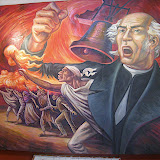
At 5:30 in the morning on September 16, long before sunrise and the normal time for church, Hidalgo rang the bells of the parish, the Parroquia de Nuestra Señora de Dolores, or the Parish of Our Lady of Sorrows, named for an image of Mary (the patron saint of Mississippi, who knew?) in which the mother of Jesus suffers at the sight of her son being crucified. Hidalgo’s cry for independence (read his supposed exact words here) would become known as the Grito de Dolores, named for the town and its parish church but which, thanks to this coincidental background, literally translates as “the cry of sorrows," or "the cry of pain.” From this parish named for the Virgin Mary, Hidalgo and his ragtag army went forth carrying a flag with, as a symbol of their American identity, the image of the Virgin of Guadalupe on it. With a history like this, is it any wonder that I think of Mexico as the land of Maria?

My Historical Adventure

Well. So much for backstory. Dolores Hidalgo is located in Guanajuato state about halfway between the city of Guanajuato and the city of San Miguel de Allende. But with our time running short, I knew Chris and I wouldn’t have time for another weekend Mexican road trip together. If I wanted to visit the birthplace of Mexican independence – and, amateur history buff that I am, I definitely did – I’d have to go myself. So, before dawn on Thursday morning I boarded a bus heading east, ready for adventure.

The first bus took me from Lagos to León (this ride before dawn), and from León I boarded a bus to the city of Guanajuato, where the Lonely Planet mentioned regular bus service to Dolores. This final leg of the trip, from Guanajuato to Dolores, was the prettiest. The bus snakes it way up into higher altitude, first offering passengers gorgeous views of the colorful city of Guanajuato (nice to see you again!) before heading even further up onto a winding highway that hugs the cliffs of the tree-covered mountainsides. I haven’t felt this much of a thrill on a bus ride since that early morning journey through the mountain jungles of Chiapas on my way to Palenque.

Five hours after leaving Lagos de Moreno my bus finally rolls in to the tiny but bustling town of Dolores Hidalgo. Upon leaving the bus I immediately see a very large shrine to the Virgin of San Juan de Los Lagos in the bus station, the only such religious shrine there. ¡San Juanita! I make a mental note to tell Chris about it when I get home.

I pull out my Lonely Planet guidebook and study its street map of Dolores. The central plaza is only a few blocks north of the bus station, so I start walking in what I hope is the right direction and I reach the plaza within a few minutes.

And then there it is: The place where it happened. Somehow this feels more like a holy place than most of the churches we’ve visited this year. It is a place where something monumental happened, right here, in this place, some two hundred years ago, an event far enough away to be legendary but close enough that its effects are still felt, like aftershocks of an earthquake. I find myself struck by this place as a link between Mexico and the United States – and so many other countries of the American continents, for that matter. Independence, I realize, is part of the common story of the Americas; it is something that binds us together as brothers.

I head to the church first, and walk inside. It’s surprisingly beautiful, though poorly maintained. There is a Taxco-like churrigueresque façade and churrigueresque side altars, all impossibly detailed sculptures of stone, metal, and wood. I sit for a moment in the pews, then walk outside, pausing at the door to look out on the plaza, as I imagine Hidalgo did on that fateful morning. Next to the church entrance is an 8-foot-tall pillar with an electronic counter on it counting down the days to Mexico’s 2010 bicentennial. 447 days, 11 hours, 39 minutes, and 7 seconds… 6 seconds… 5 seconds…

From the parish church the rebels went to the town jail and freed all the prisoners, and so I, walking their path, walked the few short blocks to the prison, which is now the Museum of National Independence. It proved to be a surprisingly excellent museum, one of the best I’ve been to in Mexico, with English translations next to all of its explanations. The independence museum mostly told the story of Miguel Hidalgo, who I had previously only known as the rebel leader who, especially in Guadalajara, is depicted principally as crazy-looking. Who knew Hidalgo was a hundred times more interesting than that?

Hidalgo, the museum tells me, was eventually captured and executed less than six months after crying the grito from the doors of his parish church. After being shot by a firing squad, his head was cut off and placed in a birdcage so that it could be hung in a prominent place in the city of Guanajuato as a symbol to would-be rebels. Hidalgo’s decomposing head hung there for ten long years while the war dragged on, but after the war was eventually sent to Mexico City where it was buried under the Monument to Independence. Is this monument the famous Angel of Independence? I’m not sure. I make a note to find Hidalgo’s head when we’re in Mexico City next week.

From the prison I walk to Hidalgo’s house, where the rebels met in secret on the morning of September 16. It is also now a museum. I was going to skip this one, until I noticed that it was run by INAH, the National Institute of History and Anthropology. INAH museums are, as a rule, really well done, so I figured I had to check this one out. I shouldn’t have. It was lame, full of replicas of various “important” documents, and all of its explanations were in Spanish. Tip: If you ever go to Dolores Hidalgo – and you should, since I’ve already told you to go to San Miguel and Guanajuato – definitely go the Museum of National Independence, but don’t bother with the house of Miguel Hidalgo. You can see it fine from the outside.

That was about all I needed to do in Dolores – and I needed to be getting home besides, what with my five-hour bus ride ahead of me – so I snapped a few more photos of the plaza and the church, grabbed a torta to go at a popular-looking restaurant, and bought a ticket for the first leg of my several-stage journey home.

Reflection (also skippable, if you like)

This has, I have to say, been a very thought-provoking week for me. I took two adventures on my own, which was an experience in its own right. Still, I thought the two adventures had nothing to do with one another, but in Dolores I realized that they perhaps had more in common than I had supposed.

My visits to Toribio Romo and Miguel Hidalgo were actually both visits to places dedicated to priests, ordained ministers, each of whom had served his parishioners in a very particular way. Each found himself opposed to powerful forces, and each, in the service of his parishioners, led their parishioners in resistance to those forces, specifically those forces that they believed threatened their parishioners’ ability to live as God intended them to live. Am I oversimplifying? Of course – but bear with me for a moment.

Toribio Romo refused armed rebellion, but he did choose a path of resistance when he continued to administer the holy sacraments to his people in full violation of the law, an act of liturgy-as-resistance that brings to mind William Cavanaugh’s Torture and Eucharist. Miguel Hidalgo, on the other hand, rejected the brutal hierarchies of his day by forging cross-cultural, cross-class relationships and building up the community of his parish through cooperative economic life. And then, unlike Toribio, he chose the path of taking up arms, uttered the Cry of Pains, and unleashed a bloody war that quickly spiraled out of his control. That last part is easy to glorify as history but hard to justify as principle; if I were writing the story as an ideal I’d prefer a peaceful resistance akin to MLK or Ghandi’s spiritually-sourced people’s movements.

Still, I’m holding Toribio Romo and Miguel Hidalgo in my head and in my heart this week, two examples of priestly vocation lived out in the Americas in the last two centuries. They are worth remembering, I think, as I continue to ponder the vocation of ordained ministry in the Americas in the twenty-first century, and as I prepare to take these many adventures back across the border.

And of course, here's my inevitable Dolores Hidalgo photo gallery:

Dolores Hidalgo

Wednesday, June 24, 2009

A Visit with Santo Toribio

Yesterday I went to see Santo Toribio Romo.


Santo Toribio Romo, for those who haven’t been to the interior of Mexico recently, is quite possibly the most popular saint in the country. To be fair, he does face stiff competition from San Judas Tadeo (St. Jude), whose image is everywhere in Mexico City, as well as one image that looks like St. George but with a person at the end of the spear instead of a dragon (if anyone knows which saint this is, please tell me!) that is especially popular among bus drivers and taxistas. But the omnipresence of Toribio Romo’s black-and-white mug is powerful, and growing.

There are at least two obvious reasons for this popularity. One is that Santo Toribio Romo is becoming the unofficial patron saint of immigrants to the United States – especially those who cross the border on foot, without papers, under the natural threat of a deadly waterless desert and the man-made dangers of the Border Patrol, the Minutemen, and immense risk involved in choosing a responsible coyote. Is it any wonder that the God-fearing faithful, who have always cried out for divine intervention in their most dire moments, would find help from a spiritual source? For these vulnerable travelers, Santo Toribio often shows up as a guardian angel, helping the migrant through a tough spot before mysteriously disappearing into the darkness. We rationalists may scoff, but the stories – and the faith of the people – are growing.

The other reason for Santo Toribio Romo’s popularity, however, is that unlike San Judas Tadeo or the Psedo-Saint-George, Santo Toribio is certifiably Mexican. He was born on April 16, 1900, right here in the highlands of Jalisco, dirt poor. He grew up under the shadow of the Virgen de San Juan de Los Lagos, and entered the seminary in San Juan when he was only 12 years old, to be ordained as a priest by the time he was 22. But of course, by now, thanks to my endless ramblings about it, you know that the 1920s were a dangerous time to be a priest in Mexico. As the government cracked down on religious practice, Toribio Romo rebelled – not with guns and knives, but instead by continuing to administer the sacraments to his people. On February 25, 1928, government troops finally caught up with him in the town of Tequila. He was shot to death in his bedroom.

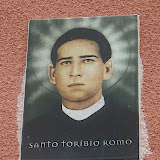
Pope John Paul II canonized Toribio Romo as a saint of the church in 2000. Twenty-four other martyrs of the Cristero Rebellion were also canonized, but none of them have yet reached Santo Toribio’s popularity. Aiding his belovedness, Chris and I have surmised, is the arresting photograph of Santo Toribio that serves as his image (see the photo at the top of this post). His eyes are almost sad, but fixed and firm, as if they are seeing his future and he is deciding in that moment that though it is not pleasant it is the path God has called him to, and he will not waver from it. Is it any wonder the saints are stand-ins for Jesus, stepping-stones to Christ?

Well. Enough background. On Tuesday I decided to visit this Mexican miracle-worker, to see Santo Toribio for myself. Chris had already made her visit with a priest in San Juan who helpfully drove her there in his car and introduced her to the priests in charge; she came home with a Santo Toribio keychain and prayer book, gifts from the administrators of the church. I, on the other hand, would be going by myself, by a series of public buses – yet another practical test of all those Spanish classes.

Santo Toribio’s shrine is in Santa Ana de Guadalupe, a tiny, tiny, tiny village outside of Jalostotitlan, a small town about two hours from Lagos by bus. Traveling through the other towns in this region helps me realize just how relatively big Lagos de Moreno really is. It is no teeming metropolis like León or Guadalajara, to be sure, and yet compared to Jalos (the popular abbreviation for Jalostotitlan) it is full of urban comforts. When my regional bus arrived in Jalos, it dropped me off at a street corner office that served as the Jalos bus station. And I thought the bus station in Lagos was small…

I walked over to the office and asked the man in an official-looking uniform how to get to Santa Ana de Guadalupe. He stared at me blankly and pointed at the corner where I had just gotten off the bus. Apparently this was the bus stop. As I was turning to go, another group of people who had been on the same bus – an friendly older gentleman and two women who seemed to be about the same age – came up and asked the official-looking person about Santo Toribio. I decided to follow these people.

We waited for about twenty minutes, and I passed the time by reading my copy of The Brothers Karamazov and trying not to look too out of place. I love traveling, but this stick-out-like-a-sore-thumb-gringo feeling is not my favorite. In a cosmopolitan city like Guadalajara, where airplanes arrive daily from foreign lands, I hardly ever feel it, but here in a rural town you really feel like a stranger in a strange land. Of course it’s a thrill, but it can be a bit terrifying all the same.

When the little bus arrived, I and my (unsuspecting) traveling companions got on board and we all rattled our way out of town. As we made our way out into the countryside, the smells became more and more pronounced. You know what I mean. Farm smells. Cow smells. Nebraska smells. Iowa smells. This was a long way from Mexico City.

We turn down a dirt road and pass under a stone arch that announces the place of Toribio Romo. There is nothing but dry grass and desert trees around this shrine; nothing is visible from here. I wonder if this is what the arches in Guadalajara were like before they were swallowed up by the growing city. I wonder what this place will look like in 10, 20, 50 years. Will it be like San Juan de Los Lagos, pumped up to a sprawling size by the development steroids of cash brought by faithful pilgrims from across North America? People in San Juan call their town’s economic health the “true miracle” of the Virgen; will Santo Toribio deliver the same economic miracle to his hometown?

If it will happen, it hasn’t happened yet. The bus driver – who is extremely friendly – drops us off at a street corner, but I don’t see anything resembling a church. This is nothing like San Juan de Los Lagos, a mad market of religious souvenirs leading to a towering basilica that is visible for miles around. Not wanting to seem uncertain, I spot a weathered tourist sign and walk firmly toward it. It’s the right move – when I reach the sign, I immediately see the stone church around the corner.

It’s almost shockingly small. Later I discover that Padre Toribio built this church himself, organizing the people and resources to get a church built in his hometown. This explains the church’s size, but still: This is the land of massive parish churches and towering basilicas stuck in the middle of small rural cities, yet the shrine for one of Mexico’s most popular saints is a tiny stone sanctuary far outside of town.

As I walk through the church doors, a woman next to me drops to her knees, and then begins shuffling up to the altar. What is it with this shuffling up to the altar on your knees thing? People do it in San Juan, too, and I’m always bewildered by it. On the one hand, it’s beautiful piety, a powerful expression of devotion that even a Protestant can’t help but respect. On the other hand, what kind of God – or Virgin or saint – wants you to shuffle up to their throne on your knees? I understand it rationally – puny human before powerful deity – but this physical submissiveness doesn’t exactly make me feel full of love for the Lord.

On the other other hand, I continue to be amazed by the Mexican faithful’s use of physical acts in their religious practice. From the Christmastime posada parades to the outdoor theater of Good Friday, Mexican Catholicism gives you something to do and not just something to think. I’ve come all the way out to see Santo Toribio – now what? I can pray silently in my head, and I do, but as I watch the woman shuffle up to the altar I find myself wishing I had something physical and physically demanding I could do during my pilgrimage, to cap it off. I make a note to file this away for further reflection later.

Outside, in the “backyard” of the little church, I find a long walkway leading to another little church. This is the Calzada de los Martires, or Walkway of the Martyrs. All along the little stone path there are cement busts and inscribed plaques to the other Cristero martyrs. Most of them are from Jalisco, but there are a few from Zacatecas, too, and at least one each in the northern border states of Durango and Chihuahua, and one, I am surprised to find, from the southern state of Guerrero. (Question: Why is Santo Toribio the patron saint of migrants, and not one of the martyr saints from a border state?)

In the middle of this walkway, there is a monument to Christ the King and the Virgin of Guadalupe, a visible rendering of the Cristero martyrs’ final cry: ¡Viva Cristo Rey y la Virgen de Guadalupe! Long live Christ the King and the Virgin of Guadalupe! The monument itself is a curious one. There is a black cross. On one side of the cross is Jesus, his arms up in the air and wearing the cloth of resurrection – this is “viva Christo Rey.” On the other side of the cross is the Virgin of Guadalupe, life size. They are positioned like two sides of the same coin – or two sides of the same cross. I have no idea what this means theologically, but it’s got to be worth a paper or two in a systematic theology class.

At the end of the walkway is another stone church, about the same size as the first one. Later Chris tells me this other church was built by Santo Toribio’s family after his death. Next to the church is a replica of Toribio Romo’s childhood home. It’s like one of those 18th or 19th century homes you can visit in certain national parks (there’s one in my grandparents’ town in Iowa), complete with furnishings from the era. This one is about the size of the living room in our apartment in Lagos. Later Chris tells me that Toribio Romo’s parents raised five kids in this one-room log cabin. The point, she tells me, is that they were dirt poor. I try to take a photo of the house, but it’s difficult to capture without the fancy restaurant built just behind it.

On my visit I miss the retablo room, where visitors put thank-you notes, thank-you paintings, and random thank-you items like soccer jerseys on the walls as an offering of gratitude to Santo Toribio. Chris tells me that on her visit one retablo struck her especially: A family gave thanks to Santo Toribio Romo for helping them to finally find the body of their daughter who had died in her attempt to cross the border. For these parents, the miracle was that their daughter did not disappear in the desert like so many other sons and daughters who perish in the wilderness; against all odds, they found her body, they could bury her, they could have closure.

As I leave the place of Santo Toribio, I notice his photo over a doorframe on a nearby house. The Christian faith represented by this devotion is so different from the Christian faith that I grew up with. Yet it is faith all the same, a powerful, fierce faith, strong as any I have encountered elsewhere. What does God see when he looks at this faith? What do you see, O Lord?

I have spent so much of my time parsing the differences between my faith and the faith of the people all around me; throughout my time here I have struggled to make sense of it all. But there are moments - moments, I think, when the truth beyond my brain breaks in - when my heart is pierced by what I can barely understand. And it's times like this when, well... when it brings me to my knees.

I sat on the side of the road for an hour and a half waiting for the little bus to come back and take me home. When it finally did, it was in the middle of the loop to a nearby town, so I rode the bus from Santo Toribio's rural church to San Miguel el Alto and then back to Santo Toribio and then finally on to Jalosototilan, where I caught another bus to San Juan de Los Lagos and finally back to Lagos de Moreno, another long day come to an end.

Santo Toribio

Monday, June 22, 2009

¡Segunda Cumpleaños en Guanajuato!

Editor's note: Just captioned the photo album in the middle of this post. Check it out.

Chris wanted only one thing for her birthday: To go home. Sadly, our flight is still three weeks away, so she had to opt for her second choice: A weekend visit to the colorful mountain city of Guanajuato.

Our globetrotting scholar spent a birthday in Guanajuato three years ago, in the summer of 2006 when she spent 6 weeks traveling around West-Central Mexico doing pre-dissertation prep work, scouting the research landscape for this year. (In case there’s any confusion: Even though I’m writing this blog about adventures, my wife is the real adventurer, having gone on one study abroad program and three solo trips to Latin America over the last decade, nearly every other year when you add it up, and now she’s leading this trip. And all this before her 28th birthday!)

On that last Mexican birthday, she was alone, and not having the best day: For breakfast, she ordered a fresh-squeezed orange juice, one of her favorite things ever – and it promptly made her sick to her stomach… again. But when I called her that evening, using a phone card and standing in the parking lot of College Mall in Bloomington, Indiana, she was feeling better: The owner of the hostel she was staying in, learning it was her birthday, had bought her flowers. She nearly cried at the sight of them, an out-of-nowhere gesture of kindness to a stranger in a strange land.

Needless to say, Chris left Guanajauto with happy memories and looked forward to another visit. This time, though, things were quite different. Rather than figuring things out anew at every turn, Chris knows the landscape here like the back of her hand. She’s mastered the bus system, traveled most of the route more than once (Guanajuato is about twice as far as León on the same highway), has been speaking her Spanish for the last 11 months rather than the last 11 days, and, when we arrived in Guanajuato, knew the route from the bus station to the well-hidden hotel without even having to consult so much as a map. Who even needs the Lonely Planet anymore?

As for me, well, this was my first visit to Guanajuato, and from the first wide-angle view from atop our hotel terrace (see the photo album below) I knew this was going to be one of the highlights of our time puebleando (a slang word meaning, awesomely, to visit little towns on a road trip) in Mexico.

Guanajuato, to put it briefly, is like Taxco but bigger and more diversified in its attractions. Both are former mining towns, born in the silver rush of the 16th century. Today, however, rather than trafficking in silver like its southern cousin, Guanajuato specializes in a Cervantes festival every October that leaves its streets and museums peppered with artistic Don Quixote tributes. Like San Miguel de Allende, the streets are full of four-hundred-year-old Franciscan and Jesuit temples surrounded by very-brightly-colored two story (but rarely more) adobe buildings. Unlike San Miguel, however, Guanajuato is anchored by a major regional university to keep itself lively – and resoundingly Mexican – all year long.

Actually, the first thing I thought of when we arrived in Guanajuato is that the place seemed like West Virginia – specifically, Morgantown, West Virginia, which is literally built in the mountains and is also a college town, home to West Virginia University. Turns out (thanks Wikipedia!) that Morgantown is actually an official Sister City of Guanajuato! Who knew?!

¡Cumpleaños en Guanajuato!


Guanajuato’s downtown is so pretty-at-every-turn jaw-dropping that it’s been named a certified UNESCO World Heritage Site. At this point I must beg your patience for a short digression. I was beginning to think, given how many UNESCO World Heritage Sites we’ve visited this year, that the United Nations is just giving out World Heritage status to pretty much everywhere. I mean, honestly – everything from the UNAM university campus in Mexico City to the ancient ruins of Xochicalco is a World Heritage Site! Turns out, though, that Mexico simply has more UNESCO World Heritage Sites than anywhere else in the Americas, with 29 sites. Italy, the country with the most, has 43 sites; Mexico, a country that is probably only a short flight from where you are, is hot on its heels. Do I need to give you any more reasons to visit this country? (Also, I will refrain from asking whether being a Catholic country makes you more likely to have World Heritage sites.)

Back to our trip. We checked into the Casa Bertha, where Chris stayed three years ago; the proprietor was just as friendly and welcoming as he was then. Chris showed me the rooftop terrace where she spent many an evening sipping tea and reading while watching the sun paint the town in different colors as it descended behind the mountains. I remember her talking about this terrace during that summer, about all the time she spent there, and it was sort of surreal to actually see it in person. Hungry, we went straight for a nearby restaurant, and stuffed ourselves on a cheap but delicious set lunch (other benefit of GTO over San Migel – way cheaper!). We spent most of Saturday afternoon pleasantly wandering the streets.

In fact, we walked around town for hours and hours and hours over the course of the weekend, and yet: I still think I’d get lost if you dropped me in Guanajuato by myself. The place is like a labyrinth, a crazy labyrinth of colorful buildings and cobblestone streets that alternately narrow and widen, that curve around at sharp angles suddenly, and are almost never horizontal but usually going either steeply uphill or steeply downhill. But this labyrinth is a dream to get lost in: Nearly every path leads to a yet another leafy little plaza with benches and a fountain in the middle. It is an absurdly pretty place to spend a weekend.

No wonder Chris wanted to come here for her birthday. We awoke early on Sunday morning, thanks to a bunch of nearby roosters who decided to wish Chris a happy birthday, and began their birthday song at 4 AM. We finally wandered outside after dawn, energized ourselves with breakfast, and set off in search of the path up the hill to Pípila.

Pípila is Guanajuato’s resident independence hero, who, a mere two weeks after Miguel Hidalgo’s first rebel yell in the nearby town of Dolores, torched GTO’s granary to give the rebel troops their first victory in Mexico’s War of Independence. One hundred years later, the city of Guanajuato built a massive statue of Pípila atop one of the surrounding hills, visible from nearly everywhere in town. You can take an inclined railway to the top of the hill to see the statue, or you can just walk up the hill along the winding cobblestone paths. Chris, knowing my love for climbing all manner of monuments in Mexico – ruins are like a playgrounds for adults! – led the way on the long walk up the very, very steep hill. And, just like in the climb to Tepozteco outside of Tepoztlan nearly one year ago (whoa), this one paid off with one of those spectacular wide-angle views – impossible to capture in a photograph, though you can see me try in the photo album above.

After that we went to find Chris’s #1 must-see in Guanajuato: The house where Diego Rivera was born, where there is now a Diego Rivera museum featuring works from his childhood to his final years. When we were in Mexico City we became serious Diego-philes, visiting every massive mural we could find. But here, in Diego’s birthplace, the collection is of smaller pieces that reveal much more of Mexico’s most famous painter. Chris loves how you can see his development over the years: First the preternatural technical skill, then several years in France, where he copied and mastered all manner of European styles popular at the time, then an increasing interest in peasant life, poverty, and the problems of industrialism, then an immersion in the ancient codices of pre-Hispanic Mexican art, and then, finally, the beginning sketches for his national-pride murals. You walk away with a new appreciation for Diego Rivera, his wide-ranging skill as an artist and the way in which he came to find his ultimate vocation as the painter of his people.

(Plus, I was able to make use of the bathroom in Diego Rivera’s house, which gives me an idea for the title of my book that Chris finds highly inappropriate. Sigh.)

From the Diego Rivera museum we went to the Cervantino museum in this Cervantes-obsessed town, an art museum that turned out to be three floors of surprisingly striking and diverse art depicting Don Quixote and Sancho Panza. Chris decided that Miguel Cervantes must be to Spanish-speaking countries what William Shakespeare is to English-speaking ones. Neither one of us has ever been able to finish Don Quixote, despite having tried more than once, but Guanajuato makes me want to try again…

We spent our final hours of the day eating and drinking our way through Guanajuato’s many outdoor cafes, stuffing ourselves on crepes, chocolate chip cookies, guacamole, quiche, cheesecake, frappuchinos, red wine, sangria, and black coffee, not surprisingly making our tummies hurt yet not regretting a single bite, or a single step in this beautiful town on a beautiful weekend for a beautiful girl who has now completed 28 years of adventurous life. ¡Feliz cumpleaños, mi amor! Hasta el proxima aventura…

Wednesday, June 17, 2009

Ojalá Que Llueva Café... Tacvba!


(Yes, the subject line is a joke that no one reading this will get. But I'm sticking with it anyway! )

Last night we went to our first concert of 2009. Concerts are a big deal for us; they've been the source of so many great Matt-and-Chris experiences... from Run DMC (yes, Run DMC) in Valpo all the way to U2 in New York City, from multiple Midwestern doses of Bruce Springsteen all the way to KT Tunstall in a tiny North Side theatre, we've been "spending our hard-earned on a rock show," as Bono puts it, since our first days together. I'd wanted to make it to a concert in Mexico at some point during our year, but with our time drawing to a close I figured it probably wouldn't happen.

But then I saw online that Mexico City chilangos Café Tacvba would be playing in the nearby metropolis of León as part of their 20 Years 20 Cities celebration tour. ¡¡Café Tacvba!! If you're interested in world music you can click here to learn more about Café Tacvba, but suffice to say that they are one of the most Mexican of Mexican bands in the 90s generation of Latin American rocanrol... and we had a chance to see them in Mexico! Naturally, we - ok, I - couldn't pass this up.

*****

When we arrived in León the line of people waiting to enter the arena was already winding around the block. The effect of this sight - a critical part of the concert experience - is hard to overstate. Up until that point you might be feeling ambivalent about your evening - so many things to do, why did I buy these tickets in the first place, the transportation is so much work - but when you see those fans lined up, a whole bunch of people excited about the same thing, well... the excitement is contagious. Your heart beats just a bit faster...

You also learn the first thing about what the concert experience will be like. Having attended the concerts of mostly, shall we say, "experienced" artists we are used to a more, er, "experienced" crowd. Most people at a Springsteen show are twice our age. Since tonight's band was celebrating its 20th anniversary, Chris expected the crowd to again be a good deal older than us. But we were wrong. The vast majority of those lined up ahead of and now behind us were in their late twenties, maybe early thirties at the oldest. In other words, our age. (Hey, this is a new thing for us!)

As we made our way closer to the arena's entrance, we checked out the tour merchandise out for sale. Choosing a concert t-shirt is one of the most difficult yet potentially rewarding aspects of the concert experience. (Yes, I wrote that with a straight face. I think there should be an Uniwatch blog for concert t-shirts. Somebody do this.) It's especially rewarding with a band that takes its visual design almost as seriously as its musical composition, which Café Tacvba certainly is. Even so, I couldn't make the call before the concert. This being Mexico, there were already stands set up outside selling cheap($10 or less) versions of the "official" concert merch, and it looked likely, given the presence of newly-arrived vendors only beginning to unpack their stuff, that there would be more after the show. Deep breath. Ok, I'll wait until after the show. Chris puts her arm around me. "It'll be ok," she says, "you'll find one you like later." My wife knows me.

Finally we walk through the turnstiles.... only to run the gauntlet of security guards waiting for us. We each get pulled aside by a different security guard to be patted down. I get approved, then turn to look for Chris again but I'm suddenly pulled aside by another security guard. He pats me down, then asks me something that I don't understand. I show him my ticket. "No no," he says, then asks me again. For all my Spanish training, I still don't understand what he's saying. Crap. I hate feeling like a foreigner. (We are definitely the only gringos here.) The security guard finally gives up, looks at my ticket, and points me in the right direction. Chris is already waiting in that hallway, her belt in her hand. "The first guard told me I had to check my belt," she tells me, "but then another guard told me I didn't have to." Crowd confusion - you gotta love it. She shrugs her shoulders, puts her belt back on, and we make our way up the stairs to the cheap seats.

The lights go down, and the show begins. The crowd goes wild. How to describe the experience? Maybe a video would help.

(This one is worth watching all the way through - at about the halfway point, the 3 minute mark, a dude comes out with a fiddle, the lead singer starts yodeling, and the song turns on a dime, Outkast-style, to become a very Mexican hoedown. Check it out!)


There's a guy next to us who is clearly a superfan. He dances like crazy throughout the show, singing all the words at the top of his voice and thrashing his arms about - a bit like the lead singer, actually, who is a crazy ball of dance-y energy. (Think: a 5-year-old on a sugar rush. A 5-year-old on a sugar rush for 3 hours. Yep.) Although our friend next to us is one of the most dedicated fans, we're amazed at how the entire crowd goes wild for so many of the songs. From the mosh pit of people at floor level pushing up against the stage to the standing-room-only up in our balcony, the crowd sings along with jubilant energy for song after song after song, their faces lit up by the extravagant light show of spotlights coming from the stage. The mass singalong: It is, hands down, my favorite thing about concerts. It's like church - but with better music. ;-)

Unlike our U2 and Bruce shows, however, we know almost none of the words to any of these songs. Oh, we've tried, of course - we've been listening to the Café Tacvba catalog on our respective iPods for the last month - but the different language makes the lyric learning curve a bit slower, even for Chris. We know lots of the tunes and a few of the first lines of several choruses, so we en up doing a lot of "La la la la bum bum bum whooooo!!!!" And with the energy of the crowd all around us, that seems to be enough. We bop our heads with joy through the wide range of Mexican-pop-folk-rock-punk that flows from band to fans and back again, and enjoy ourselves immensely.

After the show we take some time to wade through the now-two-dozen-at-least independent merchandise stands. Our favorite innovation: The concert soccer jersey. Before and during the concert, we'd noticed people in England national team jerseys with "Radiohead" on the back and an LA Galaxy MLS jersey with "Metallica" on the back, and now we find a Mexican national team jersey with "Café Tacvba on the back. Too cool - but not quite what we're looking for. Finally we settle on the fantastic cool-kid playeras you see us wearing in the photo above. Mission accomplished.

I look at my watch. 12:41 PM. The last bus left for Lagos de Moreno at 11:00. We walk to the bus station anyway, thinking it'll be the best place to find a safe taxi to take us home. It is, thank goodness, and before long we're heading out of town, watching the sea of León's city lights fading behind us, giving way to the nighttime darkness of the countryside. In twenty minutes the lights of Lagos de Moreno rise up before us. Just before 2am we finally fall into bed, exhausted, the end of another adventure across the border, this time one we'll remember with songs. Gracias, gracias por la musica...